Friday, January 23, 2009

Putting A Studio Together

So I've got a synthesizer. I'm beginning to learn how to use it. Now I need to find a way to capture what I'm doing. I need a few things:

  1. A way to record MIDI. That is, to capture the notes I'm playing on the keyboard to clean and fix them before recording the audio.
  2. A way to record audio.
  3. A way to put multiple tracks together to make a song.
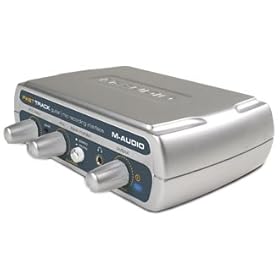
So I found the M-Audio Fast Track USB audio interface. It's got a direct line for things like keyboard or guitar, as well as a microphone port for voice and acoustic instruments. It works fairly well, other than I currently get a high-pitched hum when capturing audio that I haven't been able to filter out yet.

Then I got some software, Cakewalk Sonar, home studio for digital recording, sequencing, MIDI, and all sorts of things, including the ability to use Software Synthesizers (virtual synthesizers that only exist through software emulation) and other effects including virtual drums. When I was 17 I got one of the first versions of Cakewalk on our first PC. The product is nearly unrecognizable now from that early version, but I do have some history with it.

I'm still trying to figure out just the simplest options in Sonar, but I've figure out enough to start putting some music together.

Sounds of Analog Synthesizers

As a keyboard player, I've always been fond of any band that has keyboard and synthesizers. Whether it's strictly piano-based (Ben Folds, Tori Amos) or all synth (Thomas Dolby, Moog Cookbook). Usually I prefer a good mix of traditional instruments with keyboards (Jellyfish, Yes). I mentioned that I'd had many keyboards and synthesizers in the past. None of them, to my knowledge, were analog-based. Analog synthesizers have a different feel than any others. They sound more electronic, less "real" than other synthesizers that try (and often fail) to imitate natural sounds and instruments. For some reason I've always been drawn to the analog sound, without ever specifically realizing it.

Here's a few of my favorite examples of songs and music with analog synthesizers.

One of the earliest synthesizer hits, "Popcorn" by Hot Butter:


Moog Cookbook, a novelty band with one of my favorite artist, Roger Joseph Manning Jr., covered many Grunge and classic rock songs on vintage synthesizers:


Air is another really great band who's album "Moon Safari" is a great combination of analog sounds and acoustic instruments. Here's a couple of my favorites. "La Femme d'Argent":


"Kelly Watch The Stars" (which uses a vocoder. Seeing a live version of this song is where I first remember seeing a vocoder actually used for the first time.):


Something a little newer, Chateau Marmont "Anything & Everywhere":


One of the earliest completely electronic themes, "Dr. Who":


And just for fun, here's Moog Cookbook's remix of Air's "Kelly Watch The Stars." Someone has added an unrelated video to the song, but it makes it all the more fun and funny:

Book: Welsh's Synthesizer Cookbook

When I finally got the R3, there were dozens of buttons and knobs on the top and a giant manual that talked about how all these knobs could control things like "Resonance" and "Filter cutoff" and "LFO frequency." I had no idea what any of that was. So I went online to search for something that could teach me. I was a bit surprised that I couldn't easily find much on-line, but I was able to find several books on the subject.

I started with "Welsh's Synthesizer Cookbook" ordered from Amazon. It actually came signed directly from the author himself which was pretty cool. His specific site can be found here. With this book I was able to learn the basic fundamentals of what's called "subtractive synthesis" which is how most analog synthesizers from way back in the 60 & 70s (e.g. Moog synths) work.

It also has a large section of "recipes" for common sounds which you can use to create your own patches on most analog-style synthesizers. I've programmed in quite a few at this point, and it's been very helpful learning how to create and shape sounds. The only problem is that all synthesizers label and measure things slightly differently and there is no audio reference with the included CD to know if the sound you are creating has turned out correctly or not.

Still, it's a great reference and I'd recommend it to anyone who wants to learn how to get started in the world of analog synthesizers.

Thursday, January 22, 2009

Korg R3 Resources


Here's some stuff I've found for the Korg R3:

Blog Introduction


Hello everyone. I'm a keyboard player. I've been playing piano since the age of 6 or 7, taking formal lessons until I was 16. At that time I got my first keyboard, an awful Casio thing that I didn't know wasn't very good. Since then I've had many other better synthesizers and keyboards that I've used to create music. Eventually I sold most of them and until recently only owned a digital piano.

One thing I've never done in over 18 years of playing with synthesizers is actually learn about the fundamentals of electronic music and synthesis. I've never learned how to create my own sounds or how those sounds are produced.

In late 2008, my family and I casually stopped into a music store/guitar center while we were waiting for a particularly long haircut queue. I found a cool little keyboard with a built in microphone/vocoder. It was the Korg R3 (pictured above). That few minutes of playtime I had with it inspired my wife to find one for me for Christmas. In anticipation of receiving the synthesizer, I started to look more into it by reading reviews and watching YouTube clips. I realized that this synth was actually a lot cooler than just a keyboard with a microphone. And suddenly I realized that if I was going to get any real use out of it, I'd better learn as much as I can.

That has currently opened a Pandora's Box for me as I've recently begun learning more about things like subtractive synthesis, LFOs, Oscillators, and other elements of classic analog synthesizers. It's captured my attention and I decided to create this blog as a sort of journal as well as a gathering place for me to put all the great information I'm learning about synthesizers. So this blog is mainly for me, but maybe it will help others who are looking for similar information to assist them in learning about synthesizers.