
I just found a series of synthesizer tutorials on YouTube called "Synthesizer Boot Camp" by Simon Cann. Mr. Cann is the author of "How To Make A Noise" which I posted about earlier. Like his book, it's full of a lot of good information, though I've seen it done better and more clearly elsewhere.
Tutorial One: Modulation
Tutorial Two: Filters
Tutorial Three: Envelopes.
Presumably if more tutorials are released they can be found here: http://noisesculpture.com/bootcamp.html
Showing posts with label Tutorial. Show all posts
Showing posts with label Tutorial. Show all posts
Thursday, May 28, 2009
Synthesizer Boot Camp
Tuesday, February 3, 2009
Book: How To Make A Noise
 After getting a good introduction to Subtractive Synthesis with Welsh's Synthesizer Cookbook, I found another book that went in a little deeper into the subject of synthesis called "How To Make A Noise" by Simon Cann: http://noisesculpture.com/htman.html
This book goes in depth into subtractive synthesis as well as into other forms of synthesis such as FM synthesis, Additive synthesis, wave shaping, and more. I'm still working my way through it, but it's been fairly educational so far. One of the reasons I got this particular book was that it was pretty low-priced for all the information it seemed to contain. I got it for about $15 on Amazon. (An earlier, smaller version of the book can be found for free on the Internet.) The low price is actually a little bit misleading, though.
This book looks at programming using examples from six software synthesizers: Cameleon 5000 from Camel Audio, Rhino 2 from BigTick, Surge from Vember Audio, Vanguard from reFX, Wusikstation from Wusik dot com, and Z3TA+ from Cakewalk. This means to be able to fully understand and follow along with everything in the book you need the book, the six software synthesizers, and the specially made patches that go with the synthesizers to illustrate the concepts in the book. The author sells the patches separately for $10. The synthesizers range from $90 to $200 each.
So let's break this down:
Book: $15.00
Patches: $10.00
Cameleon 5000: $125
Rhino: $90
Surge: $150
Vanguard: $100
Wusikstation: $200
Z3TA+: $100
Total price: $790
Now to be fair, most of the synthesizers have demo versions available that can be used rather than having to buy the full product. However, you can see how it can feel a bit misleading to buy a book due to its relative cheapness and discover that to fully experience everything the book discusses, you've got to spend a lot more money.
I recently purchased the patches on-line (I'm not sure why they weren't included as a CD with the book) and have been gathering the synths to soon be able to properly follow along. Hopefully it will be worth the effort.
Wednesday, January 28, 2009
Inside Synthesis

Inside Synthesis is a blog with quite a few video tutorials on synthesis as well as reviews for synthesizer products including the Korg DS-10 on the Nintendo DS. I believe the videos were made specifically for this site: Sonic State, another synthesizer/music gear site.
These videos are very well done, and the guy who hosts them really seems to know is stuff and is surprisingly clear in his delivery of some very complex material.
Sadly, the videos are in a format that I can't seem to embed, but here are some direct links to four of the "Inside Synthesis" tutorials:
Saturday, January 24, 2009
Creating a Sound: Tom Sawyer
So I've been learning about how to make sounds. I've been listening to songs trying to pick apart the sounds in my mind and trying to figure out how I might recreate them on my synthesizers. I figured I'd start with one of the most famous synth sounds of all time, the opening growl sound at the beginning of Rush's "Tom Sawyer":
I had no idea how to make that noise despite all the different books and tutorials I'd seen so far. So I did some searching and found this page that talks about recreating the sound:
Tom Sawyer Growl Sound
There's quite a long discussion on what was used to make the original sound, and some discussion on how to re-create the sound. From there I made my first attempt to recreate the sound. It really sounded awful compared to the original sound.
TomSawyerTake1.mp3
I think I ended up passing the sound through both a high and low pass filter essentially removing most of the sound and getting nothing but the growling noise. I had to add a second sound to try to add the low E back into the sound.
After studying the write-up on the page again, I went back and started again. The page talked about modulating Oscillator 1 with Oscillator 2. I attempted that by using the R3's Cross Modulation feature.
TomSawyerTake2.mp3
This still ended up more of a hiss than a growl.
So I went back and looked some more. He talked about Rush using the Oberheim OB-X synthesizer. I found that there's a virtual version of the classic synthsizer here:
Sonic Projects OPX
I'll post more about that synth later, but using that plug-in I could see how they programmed that particular patch more carefully and attempt to recreate it on the R3. Here's the Tom Sawyer patch on the virtual Oberheim:
TomSawyerOPX.mp3
So once again I went back to start over. This time I tried to match the settings of the OP-X virtual synth with my R3 editor. The biggest difference this time was this time setting the patch to monophonic with 4 unison voices. The Oberheim has 6 which gives it a slightly more powerful sound, I believe. And then adding a slight LFO while holding out the sound.
TomSawyerTake3.mp3
It's still not completely right, but much closer to the original sound. It's amazing how just tweaking one or two little parameters can have a major effect on the sound which is why it's hard to get it completely accurate.
And just for fun, I tried to recreate it on my Korg DS-10 as well, this time just by ear.
TomSawyerDS.mp3
Yikes.
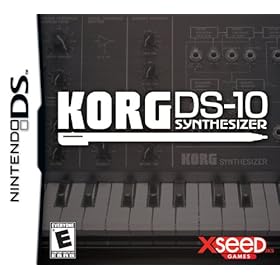
Korg DS-10

Demonstration trailer:
One general tutorial/overview:
Another general tutorial/overview from IGN:
And I couldn't embed it, but here's another great review from someone who really understands synthesizers:
http://insidesynthesis.blogspot.com/2008/09/korg-ds-10-review.html
The people who released the games have also been releasing a series of tutorials called "Synthesizer 101".
Lesson 1: Pitch
Lesson 2: VCO
Lesson 3: VCF
Lesson 4: EG (Envelope Generator)
Lesson 5: EG Part 2
Lesson 6: VCA
Advanced Lesson 7: Patch Mode
Advanced Lesson 8: Patch Mode 2
Friday, January 23, 2009
Programming Analog Synthesizers
Video on programming Analog Synthesizers
How to program analog synthesizers from Ethan Winer on Vimeo.
Subscribe to:
Posts (Atom)
